Friday, 29 November 2013

Citroen DS3 Cabriolet

 
Those familiar with the Citroen brand will remember one of its most famous and best loved models, the tiny and versatile, two cylinder 2CV.
Out of production for many years now, there's still an enormous worldwide 2CV owners club, that refuses to let the iconic model die.
Citroen had an ill fated attempt at recreating the unique ambience of the 2CV, with the C3 Pluriel,but it required far too much complicated disassembly to open the car up and the Pluriel wasn't a huge success.

Citroen I believe, now has the formula right with the DS3, incorporating one of the old Deux Chevaux's best selling features. A folding fabric roof that opens up the whole interior.
The roof can be operated at the touch of a button to any position, at speeds of up to 120 kph. Citroen also offers different roof fabric colours, so owners can personalise their DS3.   
You'd expect with only a four speed auto, and an 88 kw 1.6 litre engine, that performance would be mediocre. In the 'burbs, on take off from the lights, and in auto, the pace could be described as peppy, rather than punchy, but wind it out and it comes alive, zinging along effortlessly. 
Hustling through tight hills corners is a real hoot. The little engine is very willing when shifted from auto to manual mode, and its tall gearing and redline of 6 thousand rpm, means second and third gears are perfect for plunging in and out of corners. In short, it's eminently" chuckable."  I didn't miss the extra ratios found on most other modern cars. When driving hard there's even a "soupcon" (yes, it's a French word dear reader) of a sporty bark from the exhaust!
The DS3's ride, hints of the comfort of French cars of yesteryear and it absorbs most bumps and ruts with a smoothness belying its size.

Cruising with the roof up, there's very little outside noise. It's a quiet ride even at highway speeds. With roof open all the way, and door windows up, there's also little wind buffeting, thanks to an effective wind deflector and the side window configuration. That design also allows for the fitment of side and curtain airbags. The doors open wide for easy entry and exit.

Unlike the MINI cabriolet which has large rear and C pillar blindspots, the DS3's vision in this area is good, thanks to fixed rear quarter windows.
But, like the MINI and FIAT 500 Cabrios, and VW Beetle convertibles, when the roof is fully retracted, rearward vision in the driver's mirror disappears, as the cloth roof sits in a large folded bustle over the rear bodywork. You have to then rely on the wing mirrors. It's a mild annoyance in an otherwise exemplary design. Lock the top with the rear window exposed and it's a much better view out the back. 
 
 
With the front seats at their rearmost position, rear passenger legroom vanishes. The DS3   will seat four (five at a pinch) average sized people, or two adults and three children. The manually adjusted front seats are very comfortable and hold you nicely in position.
The boot however is tiny, accessed via a mailbox sized slot.
Just enough room for some shopping, or  a couple of pieces of soft luggage, but you have to do a lot of bending down to access it.
Citroen is one of  few car makers that thoughtfully provide a perfume stick in the dashboard with the choice of several subtle scents to keep the interior smelling nice. The vapours waft through the air vents. It's a nice detail touch. So is the taillight configuration.
I'm pretty sure no other car on the market today has 3D lenses, comprising concentric rings. The effect is something like the graphics from the old " Time Tunnel" TV series.  Vertical daytime running lights up front, distinguish it from others on the road.

 
I like the DS3 Cabriolet. It's a fun, funky car, full of French flair. Priced around 33K it's also great value.
Peter Sellen

Thursday, 21 November 2013

Citroen DS5 HDi

While some European car manufacturers have come and gone and returned o the Australian market many times, French car maker Citroen has the longest unbroken sales record of  them all.
For 90 years Citroen has sold continuously in Australia, from the versatile little 2CV,  the remarkably innovative Traction Avant of the late 1940s, to the astonishing DS, with features unheard of in the 1950s.
 

When unveiled to a stunned and delighted public at its Paris launch, more than 12 thousand orders for the DS,were placed on that very day, such was the effect it had on jaded buyers looking for something different.
The spiritual successor to the DS (or Goddess as it became more commonly known) with its unique hydro-pneumatic suspension, is Citroen's large family sedan, the C5, one of my favourite cars and a much underrated one.
Citroen has had outstanding rally successes over the decades and remains a popular marque for rally enthusiasts, winning many accolades in the WRC series.
A few years ago, Citroen revamped its small car range with the C4 and later the DS series.
I have driven most of them and was mightily impressed.
Once regarded as " quirky," which was part of their charm, Citroen's new DS crop is still very much an avante garde style leader.


This is the DS 5, and what a stunning looking car it is. Styled like no other, in the French tradition, it's a masterpiece both outside and in. Sweeping chrome spears adorn the front fenders, matched by similar chrome treatment on the door sills.
If ever a car deserved to be called a work of art, it's the DS5.
It was named Top Gear magazine UK's Family Car of the Year in 2011.
The attention to detail both inside and out is incredible. The trim stitching, fit and soft touch surfaces everywhere, just some examples. 
Citroen has packed so much into this car. It has the equipment levels and quality, of luxury competitors at more than twice the price. Which by the way, is also astonishing..a little over 51K for this diesel and 48 for the petrol model.

What you get for your money is a list of features longer than anyone's arm and unheard of in a car at this price point.
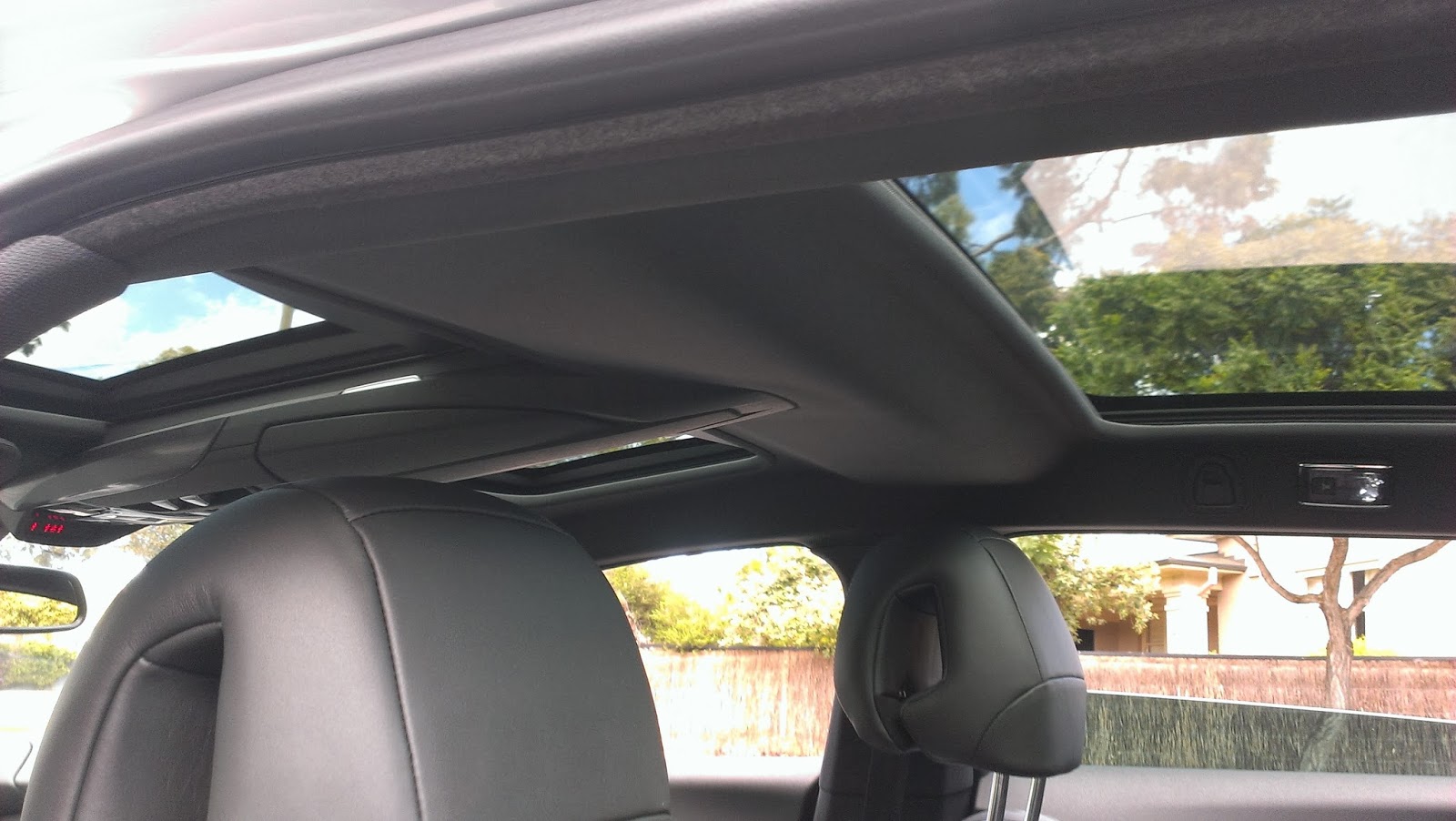
There are three separate (fixed) moon roofs, two in front and one for rear passengers.
Their sun shades operate from a  natty, sweeping overhead aircraft styled console, which also contains twin sunglasses holders and the adjust button for the heads up windscreen display, showing speed and cruise settings. There are both analogue and digital speedos.
 

The "watch strap" quality leather seats are hand made, and while not pillowy cushions, feel just right.
The driver's pew has three memory settings, and a useful lumbar massage function. Both front seats are heated.
The Denon sound system is among the best I have heard. 8 speakers produce outstanding clarity.

Visibility is good, from front quarter vent windows in the double A pillar, to fully glazed C pillars, the entire glasshouse provides ample 360 degree views, despite the DS5's low roofline.
Yes, there are quite of lot of switches and knobs on the fascia and elsewhere, but they're not that puzzling and it doesn't take long to work out what does what. Ambient lighting at night in the doors and footwells, adds to the car's appeal.
 
The 2 litre turbo diesel in this test car has 120 kw and 340nm, delivering about six litres per 100 kilometres on the combined city/highway cycles.
The DS5 weighs 1600 kilos, and acceleration is brisk, not urgent, but that's fine, most owners won't be interested in traffic light grand prix. Quiet, unfussed cruising is its forte.
The six speed auto box can be used in manual mode for more sporty driving. 

The DS5 doesn't have the smooth, supple hydro-pneumatic suspension of the larger C5 and C6, and it's set up for a more sporty ride, firm, but not overly so.  The steering wheel has a flat bottomed rim similar to those on Audis and is grippy and comfortable to hold.
Feel is good and I liked the a strong self centreing action of the wheel when pressing on through tight bends. The DS5 sits wonderfully flat on winding roads, with no sign of misbehaviour. Corners simply disappear without fuss. At speed there's no discernible noise from outside (except for some faint tyre noise, depending on the road surface.) nor under the bonnet. Double glazed windows with privacy glass also help to minimise outside noise. A thick, foam backed boot floor mat further dampens any NVH issues.
All doors operate with keyless entry, and windows can be raised remotely using the key fob. The boot opens at the touch of a rubber knob beneath the tailgate. No spare tyre, as if often the case, but a quick fix kit is included. Boot space is deep but not overly large, however it will satisfy most owners with its 468 litre volume. More space to be had of course, when the rear seats are folded. The DS5's xenon headlights are dazzlingly bright on both low and high beams, with superior spread and penetration. The headlights themselves turn with the steering into corners and have washers for their lenses. Under emergency braking, the taillights flash and hazard lights are activated.


Before you lay down your hard earned, on a BMW, Mercedes, or Audi, I urge you to also consider the futuristic, dramatically styled and beautifully crafted, Citroen DS5.
I can almost guarantee you will be won over.
Peter Sellen   


Monday, 18 November 2013

Honda Civic DTiS


Honda has become one of the last Japanese manufacturers to finally introduce a diesel engine in its Australian passenger car range. For all the waiting, it's been very worthwhile.
The 1.6 litre diesel in the new British built Civic is the equal of benchmark diesels from VW and Peugeot for power, torque and quiet running.
Fire up the little motor and there's little of the usual diesel clatter. It's very refined and smooth. Honda engineers have worked magic on noise suppression, using something called " Active Noise Cancellation." Two microphones in the cabin capture low end drivetrain frequencies, feeding them into an amplifier which then sends a reverse audio signal to the door speakers, reducing the unwanted noise frequencies by 10 decibels. 
Impressive technology in a car that costs under 27K !
The engine produces 88 kw and 300nm. Doesn't sound like much but the delivery is something else altogether.
When taking off from a standing start and engaging second gear, a giant hammer of torque hits from just over 1500 rpm up almost to the redline of 4,500, pushing you back in the seat leaving you marvelling at the sheer grunt of the engine.
Such is the volume of torque, that on a recent blast along winding roads in the Adelaide hills, only third gear was needed to despatch even the tightest of bends before rocketing out the other side on that big fat torque wave, the engine revelling when given a bootfull of throttle.
Handling is exemplary. The Civic stayed flat and poised like a sportscar.
Steering feel through the chunky fat rim of the leather clad steering wheel is excellent.
Having driven the Civic Type R with it's kidney bashing, rock hard suspension, the ride in the Civic diesel is like a Rolls Royce by comparison. It has just the right amount of compliance to easily cope with suburban ruts and bumps far better even, than some more expensive offerings.
On the move the diesel is silent on a steady throttle, only becoming slightly audible when pushed. You will get at least 1100 kilometres from a 50 litre tankful just around the suburbs, fuel consumption averaging around five litres per 100 kilometres in city driving. Expect even better consumption on the highway. There's no danger of misfuelling.
The Civic 's filler neck will only accept larger diesel fuel nozzles.
The Civic diesel is only offered in Australia with a 6 speed manual gearbox, which could hurt sales somewhat, with Australian drivers largely preferring autos to manuals.
As an example, Peugeot's first diesel cars were manual only and they sold very few. But when an auto option was imported they were snapped up. That said, because of the wide spread of torque of the Civic diesel, you can skip a couple of the lower gears for around town work, minimising the effort of shifting gears. The gear ratios themselves are quite tall. Fifth and sixth are really only suitable for the open road. You'll only need third or fourth for city driving.
The seats in the Civic are large, covered in a lovely soft material, supremely comfy, well padded and bolstered, and keep you in place well, when the going gets winding.


The dashboard is a two piece affair, with the digital only speedo housed in a sweeping curve above the lower part, which houses tachometer, fuel and temperature gauges.
Externally the Civic is  real looker, stylish, and sleek. There's a reasonably generous boot, with a full sized spare tyre.

However the turn indicators at the rear are tiny and hard to see in daylight. 
Rearward vision is hampered a bit by the split window design but it's far better than the rear blindspots in the CRZ driven prior to this test. The Civic diesel has a reversing camera for added safety.  


Honda Civic sales in Australia for October 2013 are down about 400 on the same month the previous year, but year to date almost four thousand more were sold than in 2012.
There's no question Honda has delivered a quite outstanding performance diesel for its first offering in Australia. 
I strongly recommend before buyers look at a Mazda 3,Toyota Corolla, or perhaps Hyundai i 30, a lengthy test drive of the Civic DTiS is a must.
Nice one Honda.
Peter Sellen

Monday, 4 November 2013

Honda Jazz Hybrid


The Honda Jazz has been on the market in Australia since  2008, and is one of a handful of roomy, stylish and peppy light cars, ideal for a city runabout. It's in the same class as Toyota's Prius C hybrid.
Honda has enlarged on that successful formula with the release of the Jazz Hybrid. Using a slightly smaller engine (1.3L) to the 1.5L in the CRZ, the Jazz Hybrid brings even better fuel economy than the standard petrol Jazz, despite being 70 kilos heavier, thanks to the battery pack.
Under way though, there's little to complain about.


The Jazz Moves off with reasonable urge, and even more when the right foot is fully planted. The electric motor then joins the 1.3 litre petrol engine to provide more than adequate forward motion. The CVT transmission( as is the way with all similar gearboxes) flares to higher revs and the car speed then catches up . It's not annoying and once used to it is a very smooth gearbox. The driver can lock the CVT box in lower gears for extra downhill engine braking.
The interior is stylish as before and functional and although the dashtop is hard plastic, it doesn't reflect into the enormous windscreen.
Features include auto climate control, electric windows, cruise control, blue tooth connectivity and a decent sound system.  

The Jazz Hybrid carries over the original car's extremely tight turning circle, ideal for inner city work.
On the open road the petrol engine is running almost all the time. In the 'burbs on a steady or trailing throttle, the Hybrid's energy meter shows a steady charge going to the battery. Put the foot down and the petrol engine kicks in for more urge.
The Jazz Hybrid averages around 5.5 litres per 100 kilometres in the city. You should get about 760 kilometres from its 40  litre tank around town, and that's very good indeed.
On the open road expect consumption to fall to 4.5 litres/ 100k.

Just to remind you of the mechanical wizardry going on up front, the speedo, changes from blue, indicating the petrol engine is operating, through to green when running at it's most efficient. A neat party trick. The sharp angle of the Hybrid's tiny bonnet means you won't see anything of the front of the car beyond the lower edge of the windscreen. That's fine, but a gentle nudge of the garage wall will give owners an indication of how much room they have to play with when parallel parking.

The ride on the Jazz Hybrid is only average, you'll feel most suburban ruts and bumps, but after all it is a light car. The seats however are very comfy, and there's plenty of headroom for rear seat occupants, and lots of cubbies for loose items and odds and ends. Wide opening doors make for easy entry and exit.
The Hybrid does have a flaw however that owners might find a tad frustrating. On hot days when the car is stationary in either normal or ECO mode, the idle stop feature kicks in to save fuel. But the air conditioning compressor also stops functioning, and if you are sitting for any length of time you will quickly start to feel the heat.When the petrol engine automatically restarts, so does the A/C. On most other cars with this "idle stop" feature, it can be overridden with a dashboard button. You can't on the Hybrid, there's no override to keep the  engine ( and a/c ) running.


The Jazz Hybrid sells for around 23 thousand dollars and is therefore the cheapest Hybrid you can buy. Small diesel powered light cars will give similar or even better mileage, so it's up to your personal eco bent to decide which system is right for you.
Peter Sellen.

Friday, 25 October 2013

Nissan Y62 Patrol ST-L V8


Make no mistake, the new Nissan Patrol is a gigantic vehicle, tipping the scales at almost three tonnes.
That's fine in its intended role as a tough off roader but in the suburbs it is simply huge when manoeuvring into parking spots. To help overcome this urban issue, vision all round is excellent, thanks to the vast glass house, and  large wing mirrors, which swing in out of the way  in tight spaces at the touch of a button.
You sit high, a good metre off the road and the view over the bonnet is as they say, "commanding." However it's a bit of a stretch to get in and out, if not for conveniently placed grab handles and side steps.
Nissan offers just a petrol 5.6 Litre V8, in the high line versions of the new Patrol,a detuned version of its V8 supercar engine with 298 kw and 560 nm. There's no diesel option, unless you down spec to the DX and ST Patrol, which come with a three litre, four cylinder diesel.

Under full throttle the ST-L's V8 has a lusty burble from the exhaust and a nice mechanical growl from under the bonnet. The seven speed gearbox works a treat, and has a manual override as well should you need it. Changing the transmission for off roading is done by a dial on the console, or it can be left in Auto, to deliver the best traction for the prevailing conditions.
There's nothing wrong with the petrol V8, it's only flaw is a prodigious thirst.
Fuel tank capacity is 140  litres and you will need all of that and more to go any distance. The average consumption in urban running is almost 20 litres per 100 kilometres.  Off road expect that to climb to thirty litres or more if the going is especially rugged. Constant highway cruising is more frugal, returning about 10 litres per 100 kays.


By way of comparison, Jeep's SRT 8 off road SUV rocketship has  a six litre petrol Hemi V8  developing 344  kw and 624 nm.
Toyota's Landcruiser  200 series turbo diesel V8  has 195 kw and 650 nm.  
Comfort in the Patrol is outstanding with generously padded seats, armrests and  console lid.
I last saw velour seats in a TS Holden Astra from twelve years ago, but the velour covers in the ST-L look classy with contrasting piping along the edges, and provide great comfort and grip. There's no feeling that the Patrol is top heavy in corners at speed, the suspension takes care of keeping it level despite its bulk.
There are no niceties like auto wipers and lights in the ST-L Patrol on test here, nor a lane change mode on the indicators. Small omissions but noticeable when so many other brands have these convenience features. The steering is precise and well weighted. I thought the wheel itself was adjustable only for reach not tilt, but I discovered a second lever that enables the tilt. Most cars use one lever for both.
This model has eight seats, a feature large families will enjoy, but there is no sat nav. The park brake is foot operated, rather than the now more common electrically operated device.
There are lashings of  fake wood in the cabin , but it doesn't detract from the quality of the fit  and trim materials. A reversing camera is a vital safety item on a vehicle this big and the picture on the large central dashboard screen covers a wide area. When night driving, the information screen reflects in the windscreen just below the mirror. It's a bit distracting, but not a deal breaker. Unfortunately as I have found on many new cars , the headlights are less than brilliant. On low beam they barely penetrate the night with a dull yellow glow and high beam isn't much better. Inside, all the relevant switches( and there are plenty of them,) are highlighted in red, and not easy to read at a glance. The speedo and other main dials are picked out in white.


For all its best efforts the Patrol still lags behind the only other competitor in this class, Toyota's Land Cruiser. The big Toyota commands 88 percent of the segment in the Australian market, while the Patrol has the remainder. I think it deserves more than that.
For on and off road feel and comfort the new Patrol is almost up to the level of the Range Rover  Vogue I drove a few months ago. But the Rangie is significantly more expensive.   The Patrol is priced from 53K up to 115K for the Patrol Ti L.

So if you are prepared to overlook the hammering your wallet will take each time you fill up, the Nissan Patrol ST-L V8, should not be excluded from your shopping list.
Peter Sellen  

Sunday, 20 October 2013

Honda Accord 2.4 VTEC


I have fond memories of the many Hondas I have driven, from the tiny S600 of the 1960s powered by a motorcycle engine, to the exhilarating S2000 with that amazing V Tec engine that felt like a two stroke motor.When it hit four and a half  to five thousand rpm and the other camshaft kicked in, all hell broke loose all the way to a redline of almost 9 thousand rpm. And the sound!  The supercar for the masses, the NSX will always be one of my all time favourites. 
It is that kind of heritage that brings us to today's Hondas, In this case the new Accord. When first released it was a smallish car but has now grown to nudge the larger segments.

I can't believe the amount of kit Honda has offered in this car. Heated front seats, adaptive cruise control with adjustable distance settings from vehicles in front and "Lane Watch," a camera in the nearside mirror that shows what is approaching on the inside lane. This connects to a mechanism that steers the car back onto the road should you inadvertently drift to the left. The pictures appear every time you indicate to go left or change lanes and can be activated separately with a button on the end of the indicator wand. The seat belt reminder is more than just a chime. You are chided by a female voice saying "Please fasten driver's seatbelt." With the same words appearing on the dashboard display.It certainly gets your attention! Sometimes not found in other cars in this price range, are rear seat air vents. There are no fewer than two large easy to read and use information screens one of which includes pictures from a reversing camera and satellite navigation. The driver's seat has two memory settings. There are puddle lights in all four doors,as well as a sunroof, auto wipers and lights; just some of the surprise and delight equipment in a car that has well and truly grown up.

On test here is the 2.4 litre four cylinder Accord which has more than enough power and torque for anything most owners would want from it. At idle the engine is so smooth and quiet I often had to check the tachometer to remind me it was on.Under acceleration the sound from under the bonnet is refined, no thrashing or stress.  The engine develops 129 kw and 225 nm. and averages around eight litres per 100 kilometres, The gearbox has only five ratios, but I didn't miss the extra two or three gears that many car makers now have. The Accord also has a paddle manual gearshift option on the steering wheel.

At highway speeds there is some distant whine from the tyres but it's not annoying or intrusive. What is intrusive however is the foot operated parking brake. Designed for American markets, it often collided with instep of my left foot as it searched for the dead pedal foot rest. With so many cars in the price range and lower opting for electric park brakes, maybe Honda will eventually follow suit.
There's little or no wind noise at over 100 kph. Cornering  is neutral but there could be a little more feel at the steering wheel. 
Ride in the suburbs is smooth although it does get jiggly over ruts and other irregularities, but in this respect it's about on par with others in its class. Most of the time it's comfortable, as are the seats.

The dashboard layout looks stylish, in line with more expensive offerings. Previous models were a tad cluttered and disorganised. Cabin trim, materials and look are also indicative of savvy design.
Even with the driver's seat at its rearmost travel there's still room behind it for people like me at over 183 CM or six feet two inches tall. Head room is good, even with the sunroof.
Night time illumination is good, the LED headlights appear brighter than others in its class.
I also like the single line, Audi-esque taillight configuration.

Once considered the choice of an undemanding older driver, the latest Accord goes a long way to shedding that sort of image. It's good looking and roomy. From 31 up to 51 K for the top spec V6, Honda has endowed it with luxury feel and features at affordable prices. There's absolutely nothing wrong with that.
Peter Sellen     

Tuesday, 15 October 2013

Audi A3 1.8 T Quattro


Audi now has a bewildering array of models across all the market segments, and it continues to refine and upgrade its most popular models. On test here is one example of how Audi leaves no stone unturned in an effort to satisfy buyers who want luxury, but in a smaller car. They must be doing something right, more than 18 thousand A3s have been sold in Australia since 1996.
The A3 has always been a great drive but with the new 1,.8 litre turbo and 1.4 litre engine packages it has leapt ahead of the competition. Having driven both on the recent launch of the upgraded cars on the Fleurieu Peninsula south of Adelaide, I can confidently say they are the class leaders for refinement, comfort and performance. The 1.8 Quattro is the only all wheel drive car in its class. An amazingly competent car, the all wheel drive system provides unparalleled grip.
On wide sweeping corners or twisting hills roads it is an absolute delight, firmly planted on the road without a hint of malice. There's no fear the A3 will become unsettled, inadvertently spearing you into the roadside shrubbery. At speed there is little or no wind noise, and the ride is delightfully competent and compliant.


The new A3 is substantially lighter than the previous model, losing 85 kilos thanks to an aluminium bonnet and front fenders. It's also longer than before, adding an extra touch of style. The A3 has an elegant but purposeful look about it.

Power from the 1.8 T is incredible,and effortless. Acceleration from the 130  KW and 250    nm engine presses you into the seat with willing thrust as you rocket down the road, 0  to 100 despatched in a tad over seven seconds. It's exhilarating.There are no fewer than five  suspension settings, one for every driving mood. The seven speed dual clutch automatic gearbox is operated by a central console lever. There are three modes. For general around town and cruising use D. Tap the lever back and Sport is selected, changing the engine mapping program for more enthusiastic driving. Push the lever to the left and you've entered manual drive. selecting your own gears for entertaining, press on motoring. Steering wheel paddles are there if you prefer those to the console shifter. Keyless entry and push button start make life easier for everyday ownership.
There's only one thing missing from the 1.8 T. It's so refined in all areas including the exhaust that it's going to be perhaps for some too quiet. There's none of the overrun or gear change crackle and pop found in a VW GTi for example. 
The 1,4 version has "Cylinder on Demand" technology which cuts out cylinders two and three when throttle load is light, allowing a real fuel saving even on a small engine like this. In fact Audi claims the 1,4 has the lowest emissions and fuel consumption of any petrol model in its class.And while not as torquey as the 1.8 T has more than enough performance to satisfy keen drivers, with that added fuel consumption advantage. The smooth four pot develops 90kw and 200 nm.


The interior of theA3 is typical of today's Audi craftsmanship. The company is perhaps the best in the world for top notch, almost bespoke fitments in the cabin. The infotainment /satnav screen emerges silently from a slot in the centre of the dashboard, and is easy to use, sliding quietly back into its recess, with a small flap gently closing over the slot, completing the operation when the car is switched off. After spending many hours behind the wheel I have nothing but praise for the seats. Yes they are firm to begin with but the more distance you drive the more comfortable they become. There's even a first aid kit beneath the driver's seat.I like the steering wheel, with its flat lower rim. It's identical to the wheel from the performance RS4s and others and enhances he A3's sporty feel.   


The A3 hatch will soon be joined by a sedan version in the first quarter of 2014.
The price of entry into the world of Audi's small luxury hatchbacks/sportbacks is not unreasonable. The 1.8 TFSI  is 45K and the 1.4  TFSI around 35K
If it's luxury you're looking for in a small car package and the budget suits you, the A3 is hard to overlook.           
Peter Sellen

Friday, 4 October 2013

KIA Rondo SLi

More than 20 years ago if you had a large family, there was no other choice but to buy a people mover. Some were little more than converted delivery vans.
But over time they became specialised vehicles in their own right.
Tarago, Nimbus, Odyssey, Trajet, Voyager, Zafira, MPV, Premacy, Carnival, Pyzar, Kombi, and others, became familiar names and were snapped up in huge numbers. 
In truth however, while it was okay for Mum to drive her brood in a six or eight seat vehicle, I suspect many dads felt less than comfortable being seen driving them, ( while pretending they were in something a little less prosaic.)
But over time, more and more people began purchasing multi seat, multi purpose SUVs.
There is still a market for the van type people mover, but sales have nosedived in favour of the more rugged looking off roaders across all the market segments.
KIA hoped to arrest that trend, firstly entering the fray as aforementioned, with the very successful Carnival range and later, the smaller Rondo.
This is the second generation of that car and boy is it different.

Sharp European  styling from the pen of Audi's former chief designer, Peter Schreyer,has resulted in a multi seat car that looks anything but, and goes a long way to banishing the "stigma" of mum's taxi.
I like the look of the Rondo, from the corporate grille to the smooth and shapely rear end with just enough height to give away that this is not just another hatchback There are two versions  of the Rondo, a 2 litre petrol and a 1.7 litre diesel.
On test here is the petrol engined car and it's a surprisingly good package. 122 KW and 213 nm . The engine is redlined at just under 7 thousand rpm and it sounds  and feels smooth all the way to that,while delivering acceleration that is more than adequate for a car of this size and type, considering it weighs just under 1600 kilos. In mainly town driving you'll see about 10 litres/100 ks economy. With a full load of people and luggage I would prefer the diesel. The petrol engine needs a good workout in those situations and economy will suffer.
The Rondo is very quiet, feels solid and rides exceptionally well on the road. It is very good in that respect. there's no jiggling over most bumps and it's all very composed and sophisticated. .
KIA seems to have hit a sweet spot with the Rondo's suspension, it's compliant and well tuned for local conditions. Powering through corners is a fuss free operation, it's very reassuring, with good steering feedback. As noted in other modern KIAs the steering feel is adjustable three ways. Normal, Comfort and Sport. You will decide which is best for you after a bit of experimentation.
The seats are marvellous,well padded and bolstered,and in short,very comfortable and just the right height for easy entry and exit. Probably among the best I have sat in for some time in any car regardless of cost. This SLi version has leather clad pews and steering wheel, electrically controlled adjustment with lumbar support as well. Fold out trays with cup holders are fitted to the rear of the front seats. There are more than enough storage nooks throughout the car.
To fit seven seats in a car of this size is no mean feat, but it's been achieved without making the Rondo  look clumsy or awkward. From any angle it's a bit of a looker. 
The two rearmost seats that fold flat into the cargo bay floor are mainly for children but there's no less comfort than the other rows.  Access to them is easy,with the middle row seats adjusting out of the way. A deep and practical glovebox is welcome. It needs to be large. The extremely comprehensive and weighty owners manual is the thickness of a telephone book and must run to well over 200 pages. 
There's plenty of clever detail in the Rondo. A soft touch dashboard, and generous padding on console and door armrests. The sunglasses holder overhead is lined with very plush fabric to protect lenses. Driver and passenger sunvisors have an illuminated mirror.

The latest KIAs miss out on very little in the way of equipment. Parking sensors, reach and rake steering column, colour reversing camera, a good six speaker sound system, puddle lights in the wing mirrors( that also swing out of the way when the car is locked.) auto wipers and headlights, and bright red warning lamp on the trailing edge of the driver's door.Some other more expensive makes, as I have mentioned before make do with just a piece of reflective tape here. All windows are fully auto up and down, and the rear glass descends all the way into the doors. It also has dual zone auto climate control.
Interior lighting is good, and the instruments on console and steering wheel switches for cruise, audio and information ,are highlighted in red except for the speedometer and tacho, picked out clearly in white. LED daytime running lights look cool.
The only flaw at night is the not so bright headlights. They are quite dim,with poor penetration and there's very little difference between high and low beam.
The car is more expensive than the previous model at a tad under 34K. But overall I think it's worth looking at, as the Rondo is exceptional in many ways and for larger families should be a must see and test drive. It's compact, but cleverly versatile and at the same time very stylish.
No one will be embarrassed driving it, that's for sure.
Peter Sellen   


Thursday, 19 September 2013

Holden Malibu CDX


The Malibu replaces the unloved Epica in Holden's mid sized vehicle lineup.
While the Epica was quite a good, roomy, attractively priced car, it never really caught on with buyers.
Epica and Malibu are poles apart in equipment levels and driveability.
Holden is trying to recapture a share of this market with a car named after a California beachside town. The Malibu however is born and bred in South Korea, and that's not a bad thing. Imports from GM's plants there, are fine vehicles, well made, with plenty of today's wanted features.
In fact they make up a goodly percentage of all Holdens sold in Australia.
The only Australian built Holdens, are Commodore, Statesman and Cruze.
The Malibu is a good looking car with sweeping lines, and seems almost as big inside and out as a Commodore, and from certain angles even looks like its larger sibling.
The boot is cavernous and houses a full sized spare wheel.


The Malibu is powered by either the 2.4 litre petrol four cylinder (from the Captiva range,) or a 2.0 litre turbo diesel with 117kw and 350 nm.. an uprated engine used in the Cruze.
The petrol engine CDX ,is a good, quiet performer, but when pushed you will know it's working hard. It's not as torquey as I would have liked, just 225 nm and 123 kw.
In a week of mixed urban/ open road driving the average fuel consumption never dropped below 10 litres per 100 k. The factory claim is eight.
Not to worry though, because there's a 73 litre fuel tank.
 
 
The diesel variant is not the quietest under acceleration, but it's a workmanlike sound and not overpoweringly noisy. There's enough grunt to shove you back in the seat under full throttle.
At steady throttle around town it's inaudible, and on the open road is remarkably civilised and does not intrude.
The spread of torque enables effortless acceleration and overtaking, while delivering excellent fuel economy. On a highway trip you'll easily travel well over a thousand kilometres from one tankful. In purely city driving, expect more than 800 kilometres from a tankful.
The six speed auto gearbox is good, holding a lower gear all by itself for downhill braking, although in manual mode, the up/ down buttons on the top of the gearshift lever, are not exactly intuitive to operate.
I found it awkward, but owners would most likely get used to it.
Keyless entry and start are convenience features that will appeal.
There are warning chimes and beeps aplenty in the Malibu.
You will never forget to turn off the indicators, the insistent clicking, sounds like a loud metronome.
Nor will you be able to resist the seat belt reminder chime and its ear piercing call to buckle up.
You will also know when the electric parking brake is engaging/releasing, it's much noisier than similar systems on other cars.
Despite the aural groaning from the rear, the brake holds the car well and disengages itself when you move off.
 
There's lots that will be familiar inside the Malibu. The steering wheel and indicator/ wiper stalks are standard GM fare, also found on other Holden models such as Commodore and Cruze.
 I like the curved sweep of the dashboard into the front doors. Highlighting that attractive architecture, is a thin blue led lighting feature that follows the chrome trim line running from door to fascia. Dials, buttons and gauges are easy to read and use.
The central MYLINK screen flips up to reveal a deep cubby for odds and ends and there are plenty of door pockets and a drop down stowage compartment near the drivers knee to satisfy most storage issues. A deep compartment also lies beneath the padded console armrest.
The CDX comes with heated leather front seats, auto lights and rain sensing wipers, as well as cruise control and reversing camera. Seats are firm but comfortable and the cabin is quiet on the move. Rear seat legroom is compromised by tall occupants up front, but it's satisfactory. Doors open wide for easy entry and exit.
The ride is comparable to a larger car, absorbing most suburban bumps in a civilised fashion.
At speed through corners the Malibu handles well, the equal to many others in its class and spirited driving won't have you clenching the wheel for dear life.
The steering feel on the CDX is light and the small turning circle is useful in the city.


The headlights however are disappointing, on low or high beam, they don't have enough spread or brilliance for confident night time driving. Aftermarket globes would be a useful expense.
There are four Malibu variants, priced from just over 28K to just under 36K for the diesel CDX.
There's no doubt the Malibu is well built and equipped and excellent value for money.
So the dilemma for buyers, is do they buy the locally built product, or go for the quality import with similar features at a marginally cheaper price? Time will tell.
Peter Sellen